Summary
This article shares Avi Golden’s experience with aphasia after a stroke. It describes communication challenges, recovery work, and the role of speech pathology. It explains how adaptive sports and community programs support confidence and connection. It highlights how emergency responders, clinicians, and disability organizations can better understand aphasia. It offers practical examples of autonomy, dignity, and participation.
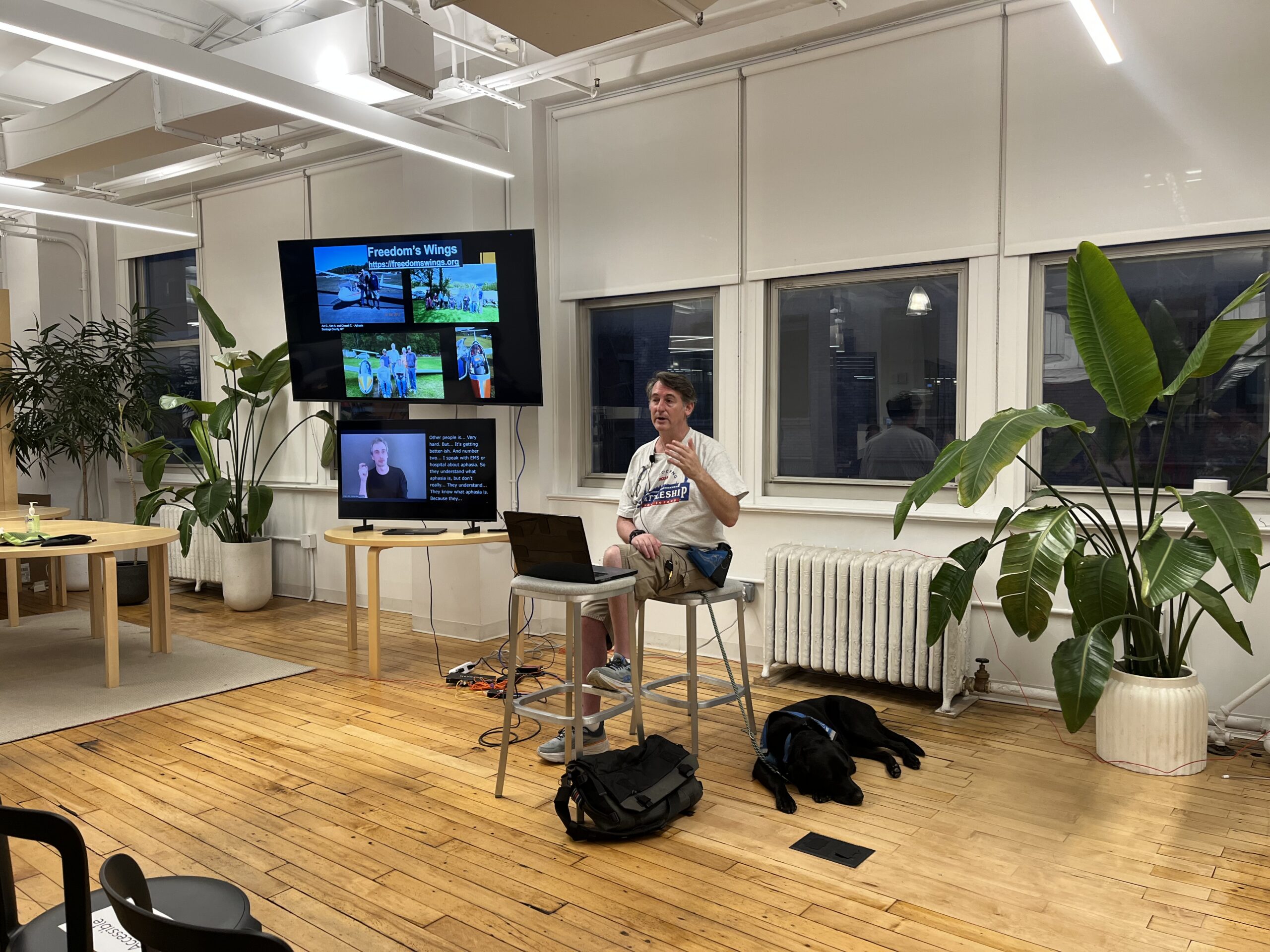
This article is based on a presentation at Accessibility New York City (A11yNYC) by Avi Golden.
Aphasia changes how a person speaks, writes, and understands language. It usually happens after a stroke or a traumatic brain injury. Every person experiences aphasia in a different way. Recovery takes time, daily practice, and strong support from professionals and community members.
This is based on Avi Golden’s story. Avi developed Broca’s aphasia after having a stroke during surgery. His experience shows the daily challenges of living with language loss. It also shows how speech therapy, community programs, and adaptive sports help people rebuild their independence.
Living with Broca’s aphasia
A stroke can change language skills in a single moment. For Avi, the stroke resulted in Broca’s aphasia. This condition makes it hard to produce speech, read, and write.
People with Broca’s aphasia usually understand what others are saying. However, they struggle to find and speak the right words. Even short and simple words take a lot of effort.
Recovery requires consistent work with speech pathologists. Daily practice helps rebuild language skills over time. Progress can feel slow, but steady effort brings real results. Speech recognition software and dictation tools can also help turn spoken words into text when writing is difficult.
Living with aphasia can be frustrating, but it also brings unexpected moments of humor. Sometimes a single word appears repeatedly without a clear reason. For months, Avi unexpectedly repeated the word “Michael” during conversations. Moments like this show how aphasia impacts word retrieval in daily life.
Training first responders and medical teams
Emergency responders often meet people who have aphasia. Many responders know the term, but they may not understand how it affects communication. When people with aphasia share their lived experiences, responders learn how to react with patience.
Outreach to police, fire departments, paramedics, and hospital staff builds vital awareness. Clear communication helps keep everyone safe during an emergency.
Medical care involves different roles. Doctors diagnose the brain injury, while speech pathologists conduct detailed language evaluations. Speech pathologists work closely with patients over time to track progress and guide daily recovery.
Community centers and support groups also help. They offer safe places where people can share their stories. These programs allow clinicians and first responders to learn directly from people living with aphasia.
Community and confidence through adaptive sports
Adaptive sports offer valuable opportunities for people with disabilities. These activities build physical strength, confidence, and social connections. Many programs are free or low cost, which helps more people participate.
A disability does not mean giving up on adventure. Trained staff and specialized equipment allow people with aphasia to participate safely in many activities. Options include horseback riding, sailing, scuba diving, rock climbing, skiing, and surfing.
These sports welcome people with many types of conditions. They serve wheelchair users, amputees, and people with hidden disabilities. Events like the No Barriers Summit bring people together to hike, share stories, and support one another.
Improving digital accessibility
Digital tools can support daily communication, but current technology has limits. Speech recognition software can turn spoken words into text. However, many systems struggle to understand non-standard speech patterns.
People with aphasia may not always realize when their speech sounds different. This makes voice tools harder to use effectively. Technology is improving, but digital tools cannot replace human speech therapy.
Designers need to build software with true accessibility in mind. Interfaces should remain simple and clear. Software should also offer flexible input options. Testing products with people who have speech difficulties ensures the tools actually work in real life.
Step toward better support and inclusion
Organizations and individuals can take action to support people with aphasia. Organizations can train their staff to recognize language challenges. Emergency workers benefit from learning simple communication strategies. Community groups can also partner with rehabilitation centers to offer accessible recreation programs.
Technology teams should consult speech pathologists when designing new tools. Clear layouts and flexible voice software help users maintain their autonomy.
Individuals can support people with aphasia through simple habits:
- Listen with patience and avoid interrupting
- Give the speaker extra time to process thoughts and form words
- Use direct, simple language without talking down to the person
- Invite people with communication challenges to join social events
Aphasia alters how a person communicates, but it does not limit their potential. Through continuous therapy, accessible tools, and community support, people can rebuild fulfilling lives after a stroke.
Resources
- World’s first wheelchair front flip
- No Barriers Summit
- Freedom’s Wings International
- Abilities Expo
- Sky Combat Ace
- The Freedom Horses
- Underwater Torpedo League
- Northeast Off-Road Adventures
- New York City Parks adaptive programs
- New York State Department of Health adapted sports and recreation
- LOF Adaptive Skiers
- Burke Rehabilitation adaptive sports and therapeutic recreation
- Adaptive Climbing Group
- Arctic Paws dog sled tours
- Life Rolls On
- Ride with InTandem
- Achilles International
- City Parks Foundation
- Skydive the Ranch
- HSA Scuba
- iFly World NYC
- Wheeling Forward
No need to read beyond this point.
Video highlights
- Life before the stroke and the sudden onset of aphasia
- Broca’s aphasia description and daily communication challenges
- Disability sports and accessible recreation
- Aphasia training awareness
- Q&A with Avi
Watch the presentation
Bio
Avi Golden is a practicing EMT and former Critical Care and Flight Paramedic with North Shore LIJ (Northwell) EMS and NY Presbyterian EMS. Avi holds a Bachelor of Science in Biology and has extensive experience as a practicing paramedic both in the US and with Magen Adom David in Israel.
After experiencing a stroke in 2007 and resulting aphasia, Avi now educates the medical and lay community and advocates for aphasia awareness. Avi is passionate about disability sports and encourages others to participate.
FAQ
What disability sports programs exist beyond major events like the Paralympics?
Many local and regional programs offer adaptive sports. Examples include gliding, sailing, horseback riding, scuba diving, rock climbing, boxing, surfing, skiing, snowboarding, offroad driving, and more. Many are free or low cost and located within a few hours of New York City.
Were these activities part of life before the stroke?
Yes. Adventure sports such as skydiving and scuba diving were part of life before the stroke. After the stroke, adaptive sports expanded those interests and created new opportunities.
How can a service dog support someone with aphasia?
A service dog can help with daily tasks that are difficult to communicate or perform. For example, a dog may retrieve items such as socks from a drawer. The support focuses on practical assistance rather than language.
What goals can people with aphasia set for recovery or awareness?
Goals may include ongoing speech therapy, community participation, and outreach to emergency responders or clinicians. Sharing lived experience helps others understand aphasia more clearly.
What digital tools support communication for people with aphasia?
Speech recognition tools can help convert spoken words into text. Some tools work well, while others struggle with atypical speech. Each person’s needs differ, and speech pathology remains essential for recovery.
How is aphasia diagnosed?
Diagnosis involves both medical evaluation and speech pathology assessment. Doctors identify the injury, while speech pathologists examine language abilities in detail and guide daily rehabilitation.
