Summary
Accessibility remediation is the technical work that removes barriers in your product’s code. Equal Entry reviews your issue list, prioritizes fixes by user journey, and works directly with your engineering team in focused 30-day sprints. By verifying results, training teams, and updating accessibility documentation, remediation turns audit findings into measurable improvements that make products more usable and inclusive.
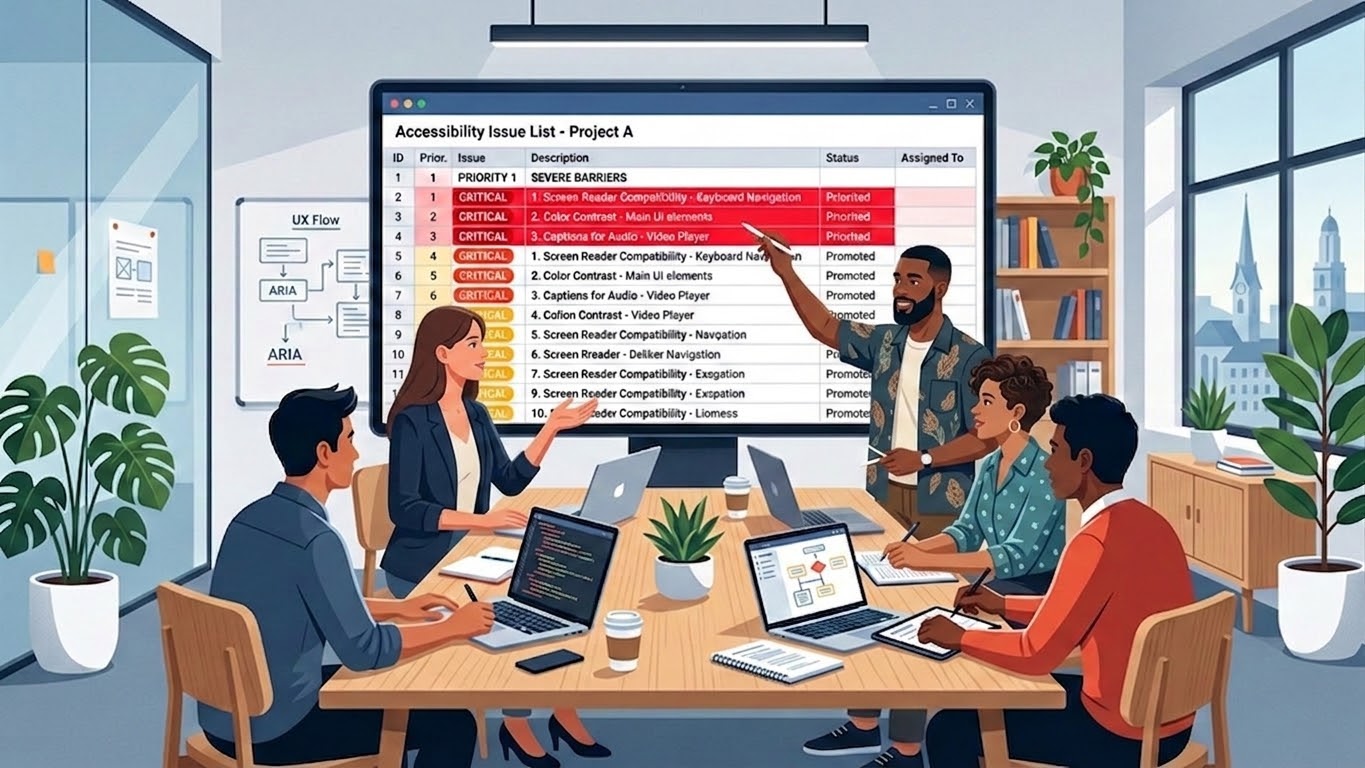
Remediation is the stage where accessibility stops being a project management exercise. Reading issue lists, prioritizing tickets, and scheduling meetings are all necessary steps, but they do not remove a single barrier. Remediation is where the work becomes a real coding exercise. Your engineers get into the technical details and make direct changes to the code so that the product genuinely works for people with disabilities.
The primary benefit of Equal Entry’s approach is the confidence that comes from knowing you are fixing blocking and severe issues first. A long issue list will always contain items of varying impact, and many of them will not prevent a person from completing a task at all. Equal Entry helps your team focus on the issues that actually stop people from using your product, ensuring that critical barriers are removed before lower-priority items are addressed.
Equal Entry also brings expertise in identifying which issues are patterns that can be resolved centrally at the template or component level. When the same problem recurs throughout your product due to a shared component, a single fix in that one place can resolve the issue across hundreds of pages simultaneously. It is more efficient to fix a single root cause in a template than to sort through and individually address hundreds of instances of the same underlying problem on different pages.
What accessibility remediation actually looks like
To make this concrete, here are four examples of common accessibility issues and how remediation resolves them.
Inaccessible form validation. A sign-up or checkout form may display error messages visually but fail to communicate them to screen reader users. Remediation involves updating the markup so that error messages are programmatically associated with their fields, announced automatically when they appear, and formatted in a way that helps every user understand what needs to be corrected.
Keyboard navigation problems. A product may work well with a mouse but become unusable for keyboard-only users if interactive elements are unreachable or if focus moves in an unpredictable order. Remediation involves correcting the focus order, ensuring all interactive elements are reachable and operable without a mouse, and verifying that focus indicators are visible throughout each journey.
Screen reader labeling issues. Buttons, icons, and form fields that lack descriptive labels leave screen reader users without the context they need to understand and operate the interface. Remediation adds accurate, meaningful labels to these elements so that assistive technology can communicate their purpose clearly.
A shared component causes issues across many pages. If a navigation element, modal, or card component contains an accessibility problem, that problem may appear on every page where the component is used. Remediating the component once removes the barrier everywhere it appears, producing a broad impact from a single, targeted fix.
How to create and integrate a workable remediation plan
A workable plan begins with a practical question: what can reasonably be fixed within a 30-day timeline? Equal Entry works directly with your team to evaluate your issues through that lens, establishing a deliberate and precise framework for deciding what should be addressed first. This time-bounded approach removes the paralysis that often comes with a large issue list and replaces it with a focused, achievable plan.
From there, we map your findings to the user journeys that matter most, such as sign-up, purchase, account access, and support. Phase one focuses on high-impact, lower-effort fixes that unblock priority tasks. Later phases handle structural changes that require more coordination.
Because Equal Entry does not sell or promote any proprietary tracking system, our approach is naturally flexible. We manage issues through a straightforward spreadsheet that allows us to work within whatever system your team already uses, whether that is Jira, Asana, GitHub, or your own internal tooling. No new tools are required, and nothing needs to be migrated. Accessibility work fits into your existing workflow rather than competing with it.
The 30-day remediation sprint
Once priorities are established, the work moves into a structured 30-day sprint. Equal Entry works primarily with your engineers and program managers during this phase, as these are the people directly responsible for making and scheduling code changes. Issues move through development and verification while the work is still fresh, and fixes land in the actual user journeys where they matter most.
Throughout the sprint, Equal Entry can conduct verification through live screen shares or email correspondence. Our preferred approach is to show your team directly that issues have been genuinely resolved in the actual user journey. When an issue has not been fully addressed, we use that same screen share to demonstrate exactly why the problem is still occurring and to walk through the available options for resolving it. Retesting uses multiple input methods, including keyboard navigation, screen readers, and zoom, to confirm the experience is consistent across different ways of interacting with the interface.
After the sprint concludes, Equal Entry can optionally deliver targeted training for your QA and design teams. This training draws directly from the work completed during the sprint, using real examples from your product to illustrate the patterns that were identified and resolved. The goal is to ensure that in future iterations, fewer issues reach the remediation phase in the first place. Equal Entry does not need to fix every individual issue on your site. Once your team has worked through a set of targeted fixes with us and has access to our knowledge base, they gain the understanding needed to test and implement accessible solutions consistently going forward.
Accessibility remediation without an internal development team
In instances where you do not have a technical team available to implement fixes, Equal Entry has experienced developers who can make those changes directly in your code. We have worked across many platforms over our years of experience. Our developers are comfortable with WordPress accessibility remediation, Shopify accessibility remediation, Squarespace accessibility remediation, and SharePoint accessibility remediation, as well as any HTML, CSS, and JavaScript-based site. If your product runs on one of these platforms or on a custom web stack, Equal Entry can step in and implement the fixes directly so that the absence of an internal engineering team does not prevent you from making progress.
How remediation affects your ACR and VPAT
If your product already has an Accessibility Conformance Report, the remediation phase gives you the opportunity to produce an updated version of that document. Assuming Equal Entry was involved in producing your original ACR, we will deliver an updated ACR at the conclusion of the sprint. This updated document shows how many issues were resolved and provides a clear record that your team made meaningful fixes within a structured and timely process.
An updated ACR is concrete evidence of your team’s capability to address accessibility issues in your product. Many procurement teams now look beyond the VPAT itself and ask how accessibility issues are being addressed and whether progress can be demonstrated over time. What they do not want to see is a VPAT where the same issues appear year after year with no evidence of resolution.
Equal Entry’s process acknowledges that not every accessibility issue can be resolved in a single cycle. What it does demonstrate, clearly and credibly, is that the most important issues are being addressed and that meaningful progress is being made. When procurement teams can see that your organization is capable of making fixes and is actively working through its issue list in a structured way, they can move forward with greater confidence, even when some issues remain.
Remediation is where accessibility becomes real
Accessibility barriers do not disappear when an audit is completed. They disappear when fixes are implemented, verified, and maintained over time. An audit identifies where the barriers are. Remediation does the work that removes them. It is the stage where findings turn into changes that improve real tasks: signing in, completing a form, making a purchase, and getting support.
A focused, 30-day sprint gives teams the momentum they need to make visible progress. Issues get prioritized based on what actually blocks users, fixes move through engineering and verification while the work is still active, and teams see improvements land week by week instead of watching accessibility slip back into the backlog.
To sustain that progress, teams should return to audit at least once a year. Products evolve, new features introduce new risks, and patterns shift over time. A yearly audit confirms that improvements are holding and identifies new gaps before they compound.
The outcome is a product that more people can use with confidence. Not because the documentation says so, but because the experience itself has changed and continues to improve.
Turn your audit findings into real progress
An audit is only as valuable as the action it inspires. If you are ready to turn your accessibility report into a stable, usable product, let us talk about your project and see how Equal Entry’s remediation methodology can help your team move forward and build inclusive experiences with confidence.
