Summary
This article explains how to support people who communicate in diverse ways, including those who use augmentative and alternative communication (AAC). It covers the Communication Bill of Rights, the foundations of language, access considerations, vocabulary systems, and practical modeling strategies. The focus is on autonomy, dignity, and meaningful interaction. It describes how to create communication-rich environments, presume potential. It also explains how to use AAC tools in ways that respect each person’s identity, preferences, and communication style.
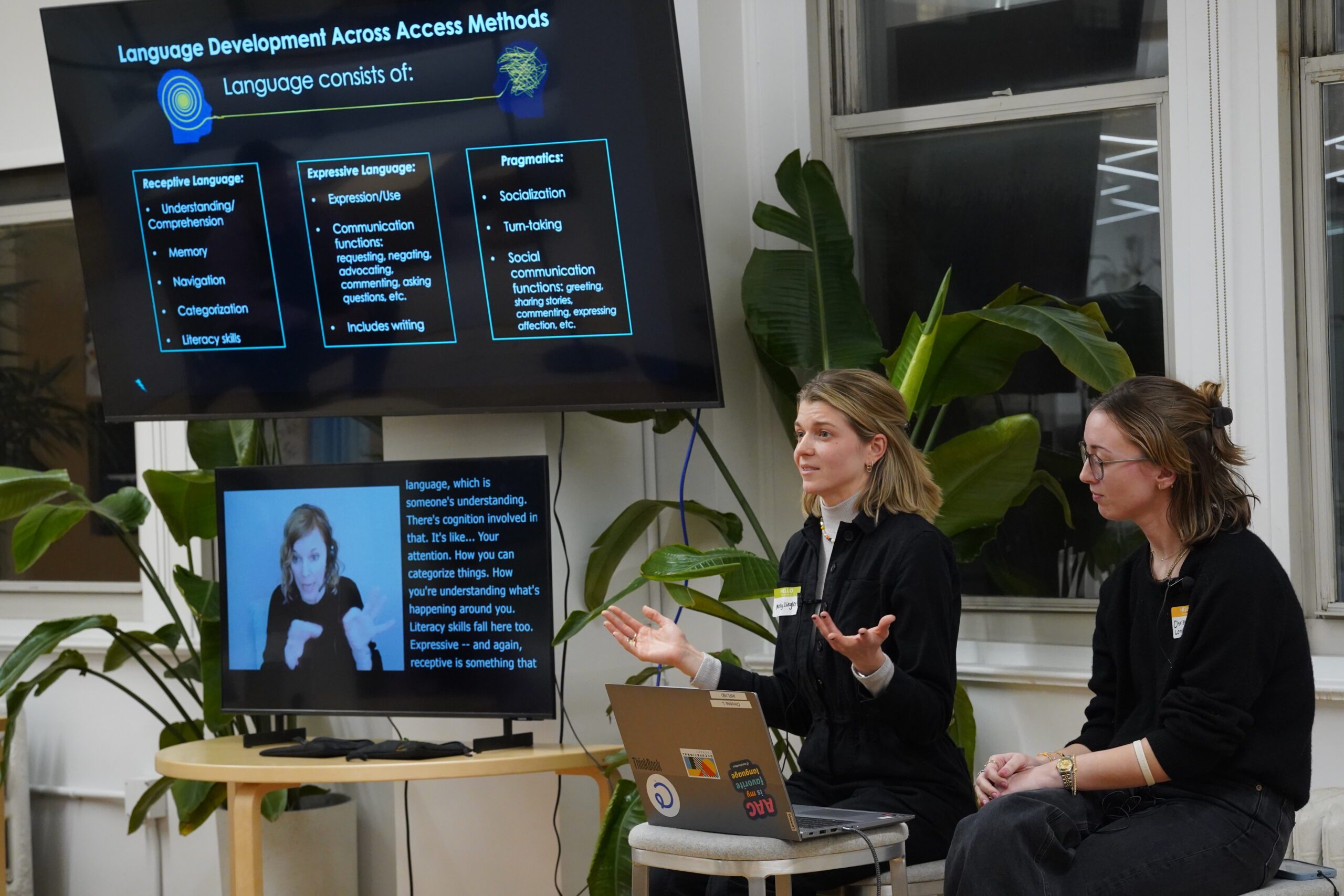
This article is based on a presentation by Molly Ziegler and Christina Lompado from the International Academy of Hope (iHOPE) at A11yNYC. It reflects the key ideas they shared about communication access and alternative communication (AAC) technology they use with their students.
What communication access really requires
Communication access begins with the understanding that every person has the right to express themselves, direct their own care, and participate fully in interactions. The Communication Bill of Rights outlines essential expectations such as being spoken with rather than spoken about, being offered real choices, and having the ability to refuse. These rights apply to all communicators, including people who do not use spoken language or who rely on augmentative and alternative communication (AAC).
Supporting communication requires recognizing that each person’s needs are unique. Communication is not a single skill but a combination of receptive language, expressive language, and social language.
- Receptive language: Understanding, attention, categorization, and literacy
- Expressive language: Asking, commenting, advocating, and declining
- Social language: Timing, connection, and interaction
When these elements are supported together, communication becomes more accessible and meaningful.
A person-centered approach involves paying attention to how someone engages, what interests them, and how they naturally express themselves. Communication may appear through gestures, facial expressions, body orientation, or eye movement. Recognizing these signals helps build trust and supports the development of more complex communication over time.
Assessing access needs and building an AAC toolbox
Access to communication depends on many factors, including motor skills, vision, hearing, and sensory processing. Some individuals isolate a finger, while others use eye gaze, large movements, or switches. Visual processing disabilities, such as cortical visual impairment (CVI), may require tactile or object-based supports instead of line drawings. Hearing disabilities may require sign language or visual cues. Understanding these needs helps determine which AAC tools will be most effective.
An AAC toolbox includes a range of options from no-tech to high-tech. No-tech and light-tech tools include picture symbols, communication boards, tangible symbols, and flipbooks. These tools are durable, portable, and essential in environments where technology cannot be used. They also support learning by offering consistent visual or tactile cues.
Mid-tech tools include battery-powered devices with recorded voice output. These tools allow users to participate in social routines, ask questions, or share jokes. High-tech AAC includes tablets or dedicated devices with dynamic displays and robust vocabulary systems. These systems require thoughtful assessment to ensure they match the individual’s cultural identity, communication style, motor abilities, and language needs.
Feature matching helps identify the right combination of tools. This process considers the person’s strengths, preferences, and access needs. It also emphasizes presuming potential, meaning every person is viewed as capable of learning language at any point in life. Communication should never be limited by assumptions or by the availability of equipment. When resources are limited, creative solutions ensure that communication opportunities are not lost.
Building vocabulary for meaningful communication
AAC systems rely on vocabulary that supports flexible, expressive communication. Core vocabulary makes up most of the words used in daily life. These versatile words allow users to express a wide range of ideas. Fringe vocabulary includes specific nouns such as names of people, foods, or places. Both types of vocabulary are necessary. Core words help build sentences, while fringe words add detail and personal relevance.
Access to a wide vocabulary allows individuals to comment, ask questions, direct actions, express opinions, and advocate for themselves. Communication goes beyond requests. People need words to complain, joke, disagree, and share their personalities. These functions build relationships and support autonomy.
Language development with AAC mirrors typical language development. Children learn spoken language by hearing thousands of hours of speech before producing their first words. AAC users need similar exposure to their communication systems. Consistent modeling and access to vocabulary help build understanding and confidence.
Modeling AAC to support learning and autonomy
Modeling means using the AAC system while speaking, showing how words and phrases can be expressed. It’s one of the most valuable ways to support AAC users. This approach provides repeated exposure without requiring the individual to imitate or respond. The most effective modeling is natural, meaningful, and connected to the person’s interests.
Verbal referencing helps connect actions and experiences to vocabulary. For example, noticing a smile and modeling the word “like” helps build understanding. Attributing meaning acknowledges the person’s communication attempts, whether through gestures, facial expressions, or body movements. This approach respects autonomy and avoids turning communication into a test.
Short phrases and one or two key words help reduce cognitive and motor demands. As understanding grows, phrases can expand. Expectant pausing gives time for processing and expression. Each person’s processing time is different. Pausing supports receptive and expressive language.
Modeling also helps users navigate complex systems with many words and categories. Exploring pages together shows where vocabulary lives and how it can be used flexibly. When specific words are missing, core vocabulary can help express ideas in creative ways. This flexibility supports communication even when systems evolve or vocabulary changes.
Creating communication-rich environments
Supporting communication means creating environments where AAC is always available, respected, and used naturally. Light-tech backups ensure communication continues when technology is unavailable. High-tech systems should be accessible throughout the day, not limited to therapy sessions. Opportunities to explore, babble, and experiment with AAC help build familiarity and confidence.
Communication partners play a key role. They provide rich language input, wait time, and respect for all communication attempts. They avoid over-testing. Instead, communication partners focus on connection, autonomy, and meaningful interaction. When communication is a shared experience rather than a task, individuals will more likely engage and grow.
Moving forward with inclusive communication practices
Supporting communication access requires ongoing attention, creativity, and respect. By presuming potential, offering meaningful vocabulary, and modeling without pressure, communication partners help individuals express themselves fully. AAC tools of all types work together to create flexible, responsive systems that honor each person’s identity and preferences.
Communication is a human right. When environments, tools, and interactions support that right, individuals can participate more fully in their communities, relationships, and daily lives.
Video highlights
- Communication Bill of Rights
- Access for communication
- AAC and communication
- Modeling
- Healthy habits with AAC
- Q&A
Watch the presentation
Resources
- Communication Bill of Rights [Cartoon version (PDF)]
- Cortical Visual Impairment (CVI) fact sheet from RNIB
- American Speech-Language-Hearing Association (ASHA) AAC source
Bios
Molly Ziegler is a communication enthusiast with a passion for assistive technology. She hails from a suburb of Chicago, IL, and loves her life in NYC as much as she loves her Midwestern roots. She specializes in finding creative ways for people of all abilities to access personally meaningful language for creative, self-expressive, social, and self-care purposes, with a specific interest in finding person-specific strategies that allow individuals to direct their care. She works with teenagers and young adults with multiple disabilities and medical complexities, as well as their families and caregivers, to ensure connection and communication across all environments using methods that are unique to each individual and support system.
Christina Lompado has worked in the field of assistive technology for over 8 years, servicing individuals with significant disabilities and complex communication needs. She is a speech and language pathologist and assistive technology provider conducting services in the educational and home settings. Christina has provided training to educational teams and therapy departments focusing on the implementation of a range of low- to high-technology devices, communication partner strategies, and material development for academic success. Christina is passionate about AAC, literacy, and access to communication all day, every day!
FAQ
What is AAC?
Augmentative and alternative communication (AAC) includes tools and strategies that support or replace spoken communication. AAC can be no-tech, light-tech, mid-tech, or high-tech.
Why is modeling important in AAC?
Modeling shows how to use AAC during real interactions. It provides repeated exposure without requiring the user to imitate or respond.
What is core vocabulary?
Core vocabulary includes common, flexible words used frequently in daily communication. These words support many communication functions.
How does AAC support autonomy?
AAC provides access to vocabulary for choices, refusals, opinions, questions, and advocacy. This supports independence and dignity.
What is feature matching?
Feature matching is the process of selecting AAC tools based on a person’s motor, sensory, visual, auditory, and communication needs.
Why is wait time important?
Wait time allows individuals to process language, navigate their AAC system, and decide what they want to express.
